I've been meaning to do this for a while, but I may actually do it soon.
Originally, Pulpwood! was supposed to be a progress blog for my Pulpwood! game (which is once again being developed). However, it has transcended past that and turned into an RPG blog that focuses mostly on my game creations or whatever.
So soon, I will probably change the site to be "Old Soul Games" or something, which is what I've been doing projects under. The content will be the same, but the name, design and layout will mostly change.
I'm off for two weeks, so I have time to do such a thing, but hopefully it'll only take me an hour or two.
So anyway, just wanted to say that!
Limitless Worlds

Saturday, August 10, 2013

Tuesday, August 6, 2013
Sixth World - A Dungeon World Hack

https://dl.dropboxusercontent.com/u/986437/sixth_world_revised.pdf
Sixth World is a Dungeon World hack that is used for playing in the Shadowrun universe. Primarily written by Chris Clouser, I jumped on at a later point mostly as an adviser/editor. Then I guess I gave him so much info, he decided to put me as co-author. Go figure.
Anyway, the game contains:
-Rules to play as the 5 classic metatypes, as well as suggestions on making stranger races
-10 Archetypes that allow multiclassing between them, keeping the "classless" spirit of SR. All your favorites are here, from Adept to Hacker to Rigger to Street Samurai
-Tons of equipment, spells, spirits, vehicles, cybernetics and rules on how to make and customize all of that! Yes, spell creation is in-built in the system
-A list of threats ranging from Lone Star Cops to Acid IC to Dragons
-Rules on stating out Sprawls and Wildernesses, allowing you to show how much of a threat Perils are to the city
-Quick and simple rules to facilitate narration over mechanics
-Rules for legwork that make a difference when it comes time to run.
-Rules for wireless hacking AND astral quests
-Optional rules for Blood Magic, Otakus and Gaeas
So yeah! Check it out!
Saturday, July 27, 2013
Something I'd Like to See
I wish someone would make a hack of Eclipse Phase using Apocalypse/Dungeon World. I would do it, but I am working on Panopticon and Pulpwood!
Yes, you heard me right, Pulpwood. It'll be a different format, but I am sure it'll still be awesome. The big draw will be a crap-ton of setting blurbs, placed on a map of the world Indiana Jones style. It's coming along, but I'm not giving a day. It'll be done when its done
Panopticon is getting close to being some kind of playtest ready. I'm almost done with all the Upgrades, and the human classes are mostly done. Still, I have to hammer out psionics, gear and basic combat, but after that it should be easy. Combat will be pretty simple OD&D fair, adjusted mostly for the use of guns. That allows things like aim, burst fire and so on. It should be pretty ool
Yes, you heard me right, Pulpwood. It'll be a different format, but I am sure it'll still be awesome. The big draw will be a crap-ton of setting blurbs, placed on a map of the world Indiana Jones style. It's coming along, but I'm not giving a day. It'll be done when its done
Panopticon is getting close to being some kind of playtest ready. I'm almost done with all the Upgrades, and the human classes are mostly done. Still, I have to hammer out psionics, gear and basic combat, but after that it should be easy. Combat will be pretty simple OD&D fair, adjusted mostly for the use of guns. That allows things like aim, burst fire and so on. It should be pretty ool
Tuesday, July 23, 2013
Preliminary Upgrades
I've been compiling ideas for that OSR cyberpunk game, tentatively entitled "Panopticon." Below is a list of
cyber/bioware, which includes modifications for the torso and the arms. I'm also having leg mods and head mods, but this is what I have so far.
Torso Upgrades
These upgrades are for systems located in your torso, or ones that run throughout your whole body.
Neoheart
Your heart has been upgraded to increase circulation and efficency. Your Constitution score increases by 1. This Upgrade can be taken three times. Simply replacing a diseased heart only costs no power, and that type of neoheart can't malfunction. Note that Constitution modified by the neoheart does not allow for additional Upgrades.
Bone Weave
Your bones have been reinforced to be extra strong and resistant to damage. You gain an additional point of natural AC. This Upgrade can be taken twice.
Gigalungs
Your lungs have been upgraded, both in size and holding capacity. You can hold your breath for up to 20 minutes, sealing off your system from dangerous gases, water and vaccuum. Simply replacing a diseased lung costs no power, and that type of gigalung can't malfunction.
Muscle Threads
Your musculature has been fortified to make you stronger and tougher. Your Strength score increases by 1. This Upgrade can be taken three times.
Nerve Splits
Your nerves have been branched and increased in output, allowing you to be faster and more responsive. Your Dexterity score increases by 1. This Upgrade can be taken three times.
Black Blood Cells
Your blood has been infused with black blood cells; hyper-fast nanobots that seek out and destroy pathogens hundreds of times faster than white blood cells. You become more resistant to disease, granting you a -2 bonus to saves involving avoiding them. This Upgrade can be taken twice.
Hardened Adipose
Your fat and skin tissues have been hardened, making you more resistant to damage. You gain 2 additional HP unmodified by Constitution. This Upgrade can be taken up to five times.
Magnetism
Your endocrine system has been augmented, releasing synth-pheremones in order to make you appear more attractive or influential. Your Charisma score increases by 1. This Upgrade can be taken three times.
Steel Gut
Your digestive system has been fortified with nanites and advanced bacteria. This makes you extremely resistant to poisons, both ingested and otherwise, granting you a -2 bonus to saves involving avoiding them. This Upgrade can be taken twice. Note that this upgrade also makes it quite difficult to get drunk, though now you can eat almost anything.
Cosmetic Alterations
These alterations include things such as animated tattoos, glowing eyes, elvish ears, strange colored skin or hair. These alterations do not cost any Power, but they cost credits like all Upgrades.
Arm Upgrades
These upgrades are used to replace and augment your arms and hands.
Cyberarm
This metallic arm replaces large portions, or perhaps the entire length, of a dismembered or missing arm. They range from high class and sleek to rusty and piecemeal. A cyberarm is needed to obtain the Sleeved Gun, Bicep Compartment and Inbuilt Compdeck Upgrades.
Sleeved Gun
You have a gun built within your cyberarm, which fires out of your palm and reloads through a feeder under the wrist. The gun must be small-arms and though only one weapon can be placed in an arm, it is possible to switch out guns (e.g. pistol for SMG). If you have two cyberarms, this Upgrade can be taken twice to provide a weapon for each.
Siberia Claws
You have mechanical or bony claws that extend out of the back of your knuckles. They function like a 1-handed melee weapon.
Bicep Compartment
You have a hollow storage space in your bicep that can only be unlocked by your brain. The space is large enough to hold a pistol or anything smaller. This Upgrade can be taken twice if you have two cyberarms.
Inbuilt Compdeck
Your Compdeck isn't handheld, but rather built into your forearm. This prevents your Compdeck from ever being stolen, unless someone wants to just rip your arm off (which some people do.)
Parker Tips
Your fingertips are laced with small barbs, allowing you to climb up vertical surfaces with little to no climbing gear.
Sworl Erase
Your fingertips have been scrubbed clean, leaving you lacking of fingerprints. While useful in avoiding the police, it's hard to access to anywhere without them.
cyber/bioware, which includes modifications for the torso and the arms. I'm also having leg mods and head mods, but this is what I have so far.
Torso Upgrades
These upgrades are for systems located in your torso, or ones that run throughout your whole body.
Neoheart
Your heart has been upgraded to increase circulation and efficency. Your Constitution score increases by 1. This Upgrade can be taken three times. Simply replacing a diseased heart only costs no power, and that type of neoheart can't malfunction. Note that Constitution modified by the neoheart does not allow for additional Upgrades.
Bone Weave
Your bones have been reinforced to be extra strong and resistant to damage. You gain an additional point of natural AC. This Upgrade can be taken twice.
Gigalungs
Your lungs have been upgraded, both in size and holding capacity. You can hold your breath for up to 20 minutes, sealing off your system from dangerous gases, water and vaccuum. Simply replacing a diseased lung costs no power, and that type of gigalung can't malfunction.
Muscle Threads
Your musculature has been fortified to make you stronger and tougher. Your Strength score increases by 1. This Upgrade can be taken three times.
Nerve Splits
Your nerves have been branched and increased in output, allowing you to be faster and more responsive. Your Dexterity score increases by 1. This Upgrade can be taken three times.
Black Blood Cells
Your blood has been infused with black blood cells; hyper-fast nanobots that seek out and destroy pathogens hundreds of times faster than white blood cells. You become more resistant to disease, granting you a -2 bonus to saves involving avoiding them. This Upgrade can be taken twice.
Hardened Adipose
Your fat and skin tissues have been hardened, making you more resistant to damage. You gain 2 additional HP unmodified by Constitution. This Upgrade can be taken up to five times.
Magnetism
Your endocrine system has been augmented, releasing synth-pheremones in order to make you appear more attractive or influential. Your Charisma score increases by 1. This Upgrade can be taken three times.
Steel Gut
Your digestive system has been fortified with nanites and advanced bacteria. This makes you extremely resistant to poisons, both ingested and otherwise, granting you a -2 bonus to saves involving avoiding them. This Upgrade can be taken twice. Note that this upgrade also makes it quite difficult to get drunk, though now you can eat almost anything.
Cosmetic Alterations
These alterations include things such as animated tattoos, glowing eyes, elvish ears, strange colored skin or hair. These alterations do not cost any Power, but they cost credits like all Upgrades.
Arm Upgrades
These upgrades are used to replace and augment your arms and hands.
Cyberarm
This metallic arm replaces large portions, or perhaps the entire length, of a dismembered or missing arm. They range from high class and sleek to rusty and piecemeal. A cyberarm is needed to obtain the Sleeved Gun, Bicep Compartment and Inbuilt Compdeck Upgrades.
Sleeved Gun
You have a gun built within your cyberarm, which fires out of your palm and reloads through a feeder under the wrist. The gun must be small-arms and though only one weapon can be placed in an arm, it is possible to switch out guns (e.g. pistol for SMG). If you have two cyberarms, this Upgrade can be taken twice to provide a weapon for each.
Siberia Claws
You have mechanical or bony claws that extend out of the back of your knuckles. They function like a 1-handed melee weapon.
Bicep Compartment
You have a hollow storage space in your bicep that can only be unlocked by your brain. The space is large enough to hold a pistol or anything smaller. This Upgrade can be taken twice if you have two cyberarms.
Inbuilt Compdeck
Your Compdeck isn't handheld, but rather built into your forearm. This prevents your Compdeck from ever being stolen, unless someone wants to just rip your arm off (which some people do.)
Parker Tips
Your fingertips are laced with small barbs, allowing you to climb up vertical surfaces with little to no climbing gear.
Sworl Erase
Your fingertips have been scrubbed clean, leaving you lacking of fingerprints. While useful in avoiding the police, it's hard to access to anywhere without them.
Field Sensors
You have had magnets, or a biological equivalent, implanted under the skin of your palms and fingers. This allows you to feel energy fields, allowing you to discern their properties, where they are going and more.
Friday, July 12, 2013
A Basic Running System
 And here is the draft system for net running! It's pretty easy since I treat running as more of a separate setting than one that requires a million rules. Still, I offer pretty easy to remember guidelines for all your running needs.
Running
When you enter the IntraNet, you are navigating the nearly infinite digital space with your mind. Your body, as well as all your gear, is sitting in situ (hopefully in a safe place). That doesn't mean you are unprotected in the IntraNet, however. Your mind is convinced it still has all its gear, but it is instead a manifestation of your mind, rather than a physical object. Still, while in IntraSpace, your brain becomes a computer for all intents and purposes. That mentally digitized gun may not be "real," but it can still lay the smack down.
Running is handled exactly like normal, real-life street missions. You have all your gear, and you look like your normal self, though you glow slightly blue and look digital. The difference is that you are no longer in the realm of the physical, but of the mental. That means when it comes down to fisticuffs, you have to flex your grey matter instead of your muscle matter.
This translates in a few ways. First, Strength is no longer used to determine melee attack bonuses and damage. Intelligence takes up that roll. Second, your Dexterity is no longer used to determine ranged attack bonuses and AC. That is now Wisdom's job. Further, like you saw in character creation, you have two new stats while running: your FC, or Firewall Class, that acts as your AC while in digital space, and your SP, or Stress Points, that act as your HP.
IntraNet combat works exactly like regular combat as well, though instead of fighting gangers and corp security, you'll be tangling with ICEs, worms and more. These programs can take up thousands of forms, similar to your Avatars.
In this way, IntraNet running is a good way to get away from the normal cyberpunk aesthetics for the GM. Want to do a fantasy dungeon crawl? Have the runners visit a IntraSpace that emulates a medieval town, where malware in the shape of a fell drake constantly frags the inhabitants.
"Dying" in the IntraNet
While exploring the IntraNet, if your SP ever reaches 0, you will become "fragged." Fragging basically is the break-up of your digital form, causing your mind to refuse a connection with the IntraNet, thus jacking your consciousness out of the Net and shoving it back in your body. You will be unharmed, but mentally, you'll be exhausted. Fragging occurs after 1 minute of reaching 0 SP, so the runner's partners have time to revive him before he is booted out. SP heals at the same rate as HP.
However, if you reach into negative SPs, that could be a serious problem for you. When you plunge down into the negatives, your mind starts reeling and trying to destroy the "infected" parts of your brain to revive you. Your consciousness stays in the IntraSpace as your brain does its work, and you must make a Will save to stabilize, similar to stabilizing physical wounds.
If you do manage to stabilize, you are fragged instantly and tossed back into your body. People with negative SP will not only be mentally tired, but they'll often be confused, confrontational, depressed and forgetful until
their brain manages to self repair itself. SP can also be restored through visits to a psychologist, often called "brain docs". These aren't so much licensed psychoanalysists, but more programmers who jack into your access port and try to root out malicious programs. Both natural and assisted healing at negative SP works exactly like healing similar HPs.
At -10 SP, the runner is fragged instantly, shoved into his body, and either becomes irreversibly comatose or incredibly insane. That means it's time for a new character.
It is important to stress that when you are in the IntraNet, your body must be safe. While running, you can easily be killed, kidnapped or worse. Further more, if you are unexpectedly jacked out, your conciousness will be stuck in the IntraNet as your body stays as a potato. You can rejoin with your body if you can find where it was transferred to, but that in itself is a whole other adventure.
Entering, Exiting and Moving in the IntraNet
The actual process of entering the IntraNet is fairly easy; find a safe and comfy place to rest, insert the Jack Wire into your access port, and sink into the Net. Where you arrive in the IntraNet is a different story. Every IntraSpace has an IP address, similar to current computers. If you know the IP number of the IntraSpace you want to visit, you'll arrive there with little complications once you Jack in. A good deal of IP numbers are easy to find, but some, such as the IP of a megacorp's stock portfolio, will be extremely hard to locate and may require real-life hacking and infiltrating to get access to.
Most IPs won't actually drop you inside the IntraSpace, but rather right in front of it. If you want to get in,
you'll have to do it the old fashioned way.
If you don't know the IP, good luck. The IntraNet is vast, some say infinite, and finding anything is a bitch. You may find what you are looking for by wandering, as similar IP addresses are placed close together physically, but don't expect to drop into an IntraSpace city and find a gun smuggler's hideout with no effort. If you enter the IntraNet without knowing the IP, you'll drop into your personal IntraSpace, which usually takes the form of an apartment.
Entering and getting place to place in the IntraNet is fairly easy, but exiting is a different story. As stated in the previous section, getting fragged is the forceful way to leave the IntraNet. The willing way requires you to go back to the IP you entered from. Yes, this means you can't just go to the IntraSpace's core, grab the data you want, and then Jack out. You have to escape with the goods. However, once you get back to the IP, jacking out is basically instant.
The Core
All IntraSpaces have something called a core. The core represents the source code used to write the IntraSpace, as well as the hard drive which contains the more important and hidden files. It also serves as the central processing power of the IntraSpace. If you want to modify or extract from the IntraSpace, you have to access the core.
Cores are usually centrally located, and are not hard to miss. The core is often in its own heavily guarded room, and the core's room itself is high vaulted and empty. In the middle is the core itself, a floating piece of geometry that constantly shifts and fluctuates with information and code.
Actually accessing the core is difficult, as the cores are fairly powerful AIs that will try to destroy the runners. Cores can be dealt with like any enemy, but these creatures are dangerous. Not all cores are insanely powerful, though; accessing the core of a digital coffee shop will usually only take a quick battle or round of negotiating. However, destroying a megacorp or government core will be a drawn out battle that may result in some fragging.
Once the core is defeated, runners won't have long until the core's back-up systems activate. These could be alarms, self destruct systems, or even a full reboot. Runners have a limited time to access or alter the information they wish, represented by an extended Intelligence check. Weak cores can take up to 20 minutes to activate their back ups, while powerful ones only need about 1 minute. This is complicated by the fact that more powerful cores will need more successes on the extended check to get the information you want. Once the runner does get what he wants, it's time to bolt.
Hacking in the IntraNet
Hacking with your Avatar in the IntraNet is fairly difficult, if not impossible. What an Avatar does to an ExtraNet is avoid, destroy and circumnavigate malicious programs in order to get to data files. However, most items in the IntraNet ARE programs. The Avatar simply doesn't know how to infilitrate individual programs to access their source codes.
Well, that's not really true. Not all Avatars can.
Some very illegal, very powerful and very expensive Avatars exist, and they are known as Devas. Devas are extensions of Avatars, so you can have a rank 3 Deva. Devas can hack items in the IntraNet, and the hacking functions just as Avatar hacking. Some things are too powerful for even the Deva to hack, such as an IntraSpace's core. What is hackable by the Deva is up to the GM.
Thursday, July 11, 2013
A Basic Hacking System
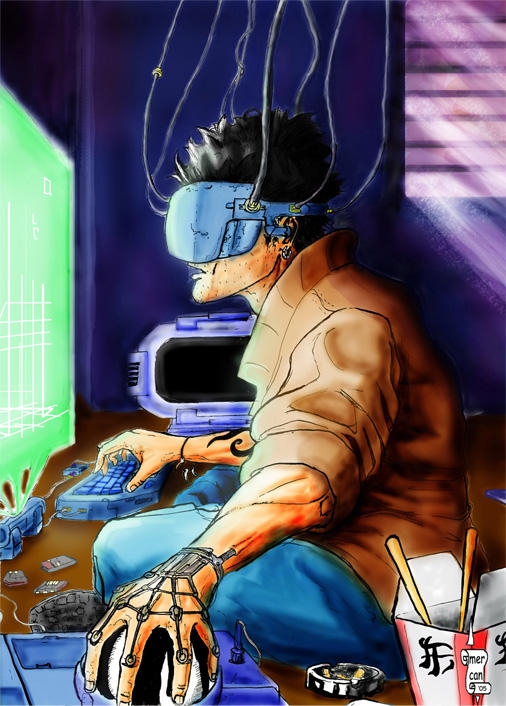
These rules are supposed to be both quick and cool. I like the idea of have your personal assistant jump into an ATM, swim through the files while dodging ICEs, and then eventually proudly announcing 2000 credits have been transferred to your account. It also brings in hacking combat without making it too complex. Originally, the Executables were going to be basically Avatar equipment, but I think treating them as bonuses is quicker and less book keeping.
Hacking
Almost everyone in modern society has a CompDeck, and you're no exception. Though most CompDecks are only used to browse the IntraNet, play games or other personal matters, you have tailored yours into a hacking machine.
Every CompDeck has an Avatar, a small helper program that represents that limited intelligence the computer has. The Avatar can take any form you wish, from a dragon to a businessman to a sexy lady. The Avatar, which rests or stands on the back of your hand when you use your CompDeck, basically performs the CompDeck's functions for you, serving as a digital helper and more.
Avatars are also the programs that actually hack the ExtraNet. They plunge into the ExtraNet, rooting around and fighting off counter measures to perform the task you want.
Avatars are based on their Rank. They are ranked from 1 to 5, with all characters starting with a rank 1 Avatar. The rank serves as the Avatar's health bar, the Avatar's hacking effectiveness and the amount of Executables he can attempt.
ExtraNet systems also have a rank that acts the same as Avatar rank. This rank represents the various firewalls, re-routes and fake files the Avatar must navigate. However, their health bar can reach higher than 5 depending on the system. ExtraNets can have Executables as well, but usually only half as many as an Avatar of an equivalent rank.
Hacking is basically a quick one-on-one battle between the Avatar and the ExtraNet. Unless the ExtraNet is particularly strong, the Avatar usually goes first. The hacker rolls a d6, and if it is less than or equal to the Avatar's rank, the Avatar has made progress in hacking. The Avatar deals damage equal to the difference between the roll and the Avatar's rank (minimum of 1) to the system. If the system reaches 0 health, the Avatar has breached through all the security and the hacker can manipulate the ExtraNet how he pleases.
Like combat, after the Avatar makes his attempt, the ExtraNet will attempt to ward off the Avatar. The GM does the same d6 roll as the Avatar did, and if he succeeds, he deals the difference in damage to the Avatar. If the Avatar ever reaches 0 health, it is booted out of the ExtraNet and the hacker is pinged. When the hacker is pinged, it means the local authorities are actively looking for you for the crime of "unlawful data manipulation." You should start running.
Be aware that at any time, the hacker can abort the attempt and withdraw the Avatar. The Avatar may have some scrapes, but you won't be pinged and can safely lick your wounds.
As both the Avatar and ExtraNet take damage, it is harder and harder to perform well. When damaged, your rank temporarily decreases to where your health is. So if a Rank 5 Avatar took 2 damage, you would have to roll a 3 or lower on a d6 to deal damage to the ExtraNet.
If the Avatar reaches 0 health, it's out of commission until the hacker can wipe his hard drives, restore memories and so on. The process takes about 8 hours, and afterwards the Avatar is back up to it's full rank.
It seems hacking may be difficult, but the Avatar has some tricks up its sleeve in the form of Executables.
Executables are small bonuses that Avatars (and hackers) can use to better attack the ExtraNet. They represent backdoors, trojans and malware the Avatar unleashes to get what it wants. The Avatar gets a number of Executables per day equal to their rank. This number doesn't decrease if the Avatar takes damage.
By "burning" an executable, the Avatar can do one of the following things
1. Instantly restore 1d3 health
2. Block 1d3 damage from an ExtraNet attack
3. Use the Hacker's Intelligence roll to hack, rolling d6 for damage. Backgrounds do apply.
4. Instantly re-roll a hack attempt
5. Cause the ExtraNet to re-roll their hack
6. Deal an additional 1d3 damage to the ExtraNet
Be wary, as some well protected ExtraNets have Executables as well.
Blitz Hacking
Blitz hacking is the term used when multiple hackers attempt to infiltrate an ExtraNet. Though one Avatar could hack the Rank 5 Megacorp Door Lock with 10 health and 4 Executables, it won't be an easy task. He'll need a little help from his friends
Any amount of hackers can work together, but usually 2 or 3 is the norm. There should be a leading Avatar, who actually does all the hacking, and the support Avatars.
While Hacking, support Avatars don't really do any active hacking. Instead, they can use their Executables on the leading Avatar, and they can also intercept damage. A support hacker can take the lead should the lead hacker fell, taking up the job of damaging the ExtraNet. Further, none of the Hackers are pinged until all the Avatars are knocked out to 0 health.
Be advised that ExtraNets can also Blitz Hack, with local ExtraNet objects teaming up to destroy a significant threat. It's not common, but it can happen.
Hacking Hackers
Avatars can actually hack other CompDecks. This functions as an ordinary hack, treating the opponent's CompDeck as its own ExtraNet. However, the opponent's Avatar will quickly make his master aware of the act, upon which he will probably draw a pistol and attempt to give you a second mouth.
Tuesday, July 2, 2013
Some New Races for Mutants & Machine Guns
Mutants & Machine Guns is a cool little post-apocalypse RPG that come in at around 8 pages. In it, there are guidelines for playing a few types of characters, namely humans, mutants and mutated animals. While this is cool, I feel M&M (not to be confused with that superhero game) can really wander into crazy post-apocalypse territory without really breaking the system. So below are some brief races I think would work out pretty well.
Mutated Plants - Pick a plant type (Cactus: gets Spike Growth mutation; Tree: Gigantism mutation; Mushroom: Acid Spit mutation; Flowering/Fruit Bearing: Enhanced Healing mutation). Rolls 1d6 + 8 for health and gets 2 mutations
Cyborg - Can install 10 TU of equipment into his body, representing cybernetic parts. Can't mutate, but can take up to 20 RP. Rolls 1d6 + 10 HP.
Android - Doesn't need to eat, drink, sleep or breathe. Can't mutate, but can take up to 20 RP. Gains 2 mutations that represent android model. Rolls 1d6 + 8 HP.
Mutated Plants - Pick a plant type (Cactus: gets Spike Growth mutation; Tree: Gigantism mutation; Mushroom: Acid Spit mutation; Flowering/Fruit Bearing: Enhanced Healing mutation). Rolls 1d6 + 8 for health and gets 2 mutations
Cyborg - Can install 10 TU of equipment into his body, representing cybernetic parts. Can't mutate, but can take up to 20 RP. Rolls 1d6 + 10 HP.
Android - Doesn't need to eat, drink, sleep or breathe. Can't mutate, but can take up to 20 RP. Gains 2 mutations that represent android model. Rolls 1d6 + 8 HP.
Subscribe to:
Comments (Atom)